
Seattle Seahawks Super Bowl History: Two Titles, Four Trips
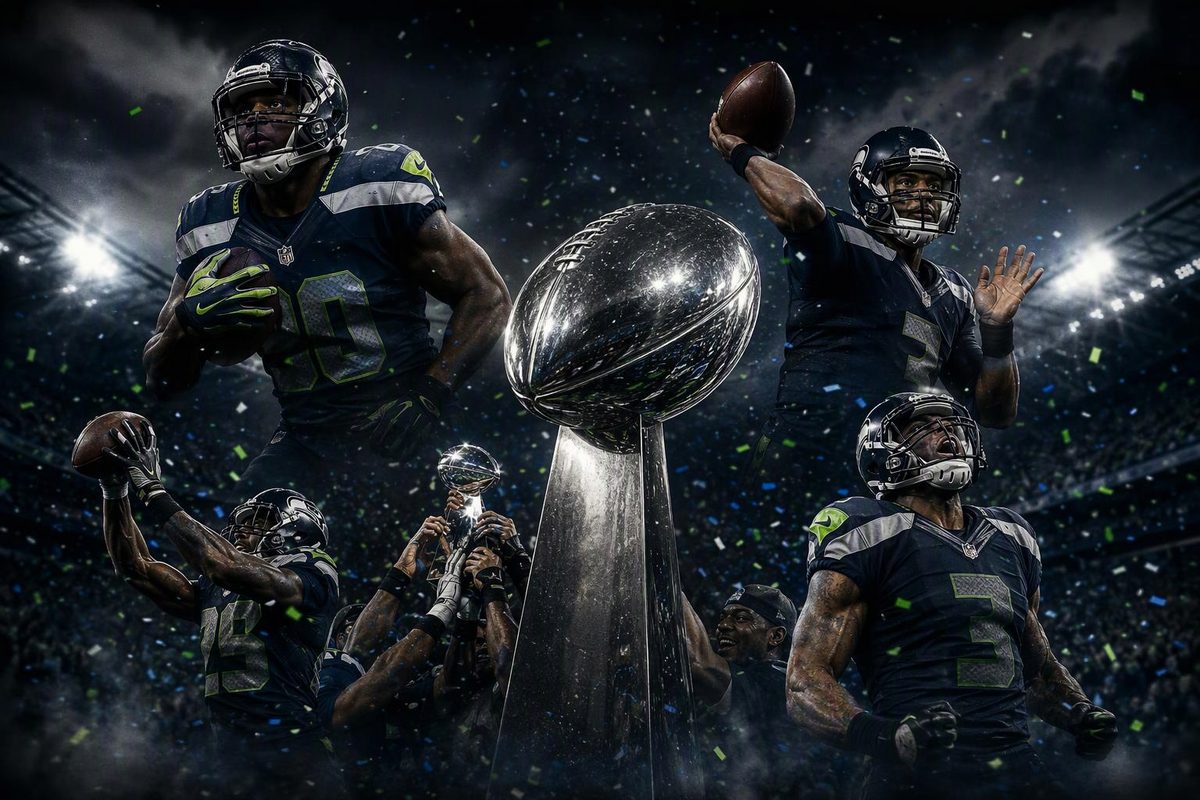
Seattle’s four Super Bowl appearances, from the 2005 season to the 2025 championship: scores, dates, key plays and the two title-winning teams.
Twelve seconds into Super Bowl XLVIII, Seattle already had a lead. Denver’s opening snap became a safety—the first score in a game the Seahawks would win 43–8 to claim their first championship. Contemporary reporting captured that abrupt beginning. Twelve years later, Seattle lifted the Lombardi Trophy again, this time after beating New England in Super Bowl LX.
As of October 10, 2026, the Seahawks have appeared in four Super Bowls and won two, for a 2–2 record. Their championships belong to the 2013 and 2025 NFL seasons, although the games were played in February 2014 and February 2026. Pro Football Reference’s franchise record lists both titles and all four appearances.
Every Seahawks Super Bowl appearance
The season column identifies the NFL season being decided, not the calendar year of the Super Bowl. Final scores below put the winning team first.
| NFL season | Super Bowl | Game date | Result | Venue |
|---|---|---|---|---|
| 2005 | XL (40) | February 5, 2006 | Lost: Pittsburgh 21, Seattle 10 | Ford Field |
| 2013 | XLVIII (48) | February 2, 2014 | Won: Seattle 43, Denver 8 | MetLife Stadium |
| 2014 | XLIX (49) | February 1, 2015 | Lost: New England 28, Seattle 24 | University of Phoenix Stadium |
| 2025 | LX (60) | February 8, 2026 | Won: Seattle 29, New England 13 | Levi’s Stadium |
For the league-wide sequence, see our history of Super Bowl champions.
Before the Super Bowls: an AFC contender becomes an NFC champion
Seattle began play in 1976 in the NFC, moved to the AFC in 1977, and returned to the NFC West during the NFL’s 2002 realignment. Its first conference-title-game appearance came under Chuck Knox after the 1983 season: the Seahawks beat Denver and Miami in the playoffs before losing 30–14 to the Los Angeles Raiders in the AFC Championship Game. All four of Seattle’s eventual Super Bowl berths came as NFC champion. Pro Football Hall of Fame histories document the early run and conference realignment.
Super Bowl XL: Holmgren’s breakthrough ends in defeat
Mike Holmgren’s 2005 Seahawks went 13–3 behind quarterback Matt Hasselbeck and league MVP Shaun Alexander. Their offensive line featured Walter Jones and Steve Hutchinson. Playoff wins over Washington, 20–10, and Carolina, 34–14, finally sent the franchise to its first Super Bowl in its 30th season. HistoryLink’s account by Glenn Drosendahl traces that breakthrough.
In Detroit, Seattle outgained Pittsburgh 396–339 but lost 21–10. Two explosive Steelers touchdowns—a 75-yard Willie Parker run and Antwaan Randle El’s 43-yard pass to Hines Ward—helped decide the game. Hasselbeck’s touchdown pass to Jerramy Stevens brought Seattle within 14–10 in the third quarter, but the Seahawks never scored again. The game record shows the scoring and yardage contrast.
Disputed officiating remains part of XL’s history. Referee Bill Leavy acknowledged mistakes in 2010, but that does not establish that Seattle would otherwise have won. Holmgren’s response to that admission was measured: “Had we played better and coached better, those calls might not have made a difference.” ESPN reported his reaction.
Super Bowl XLVIII: the first championship
Pete Carroll’s 2013 team paired Russell Wilson and Marshawn Lynch with a defense whose celebrated secondary—Richard Sherman, Earl Thomas and Kam Chancellor—formed the core of the “Legion of Boom.” Seattle led the NFL in regular-season points allowed, yards allowed and takeaways, the first team to lead all three categories since the 1985 Bears. The Hall of Fame’s franchise retrospective places that defense in context.
The championship game turned that strength into a rout. Seattle led 22–0 at halftime, helped by Malcolm Smith’s 69-yard interception return. Percy Harvin returned the second-half kickoff 87 yards for another touchdown, and Denver did not score until the final play of the third quarter. Smith earned MVP honors; Wilson threw two touchdown passes without an interception. The 43–8 final delivered Seattle’s first Lombardi Trophy.
Super Bowl XLIX: one yard from a repeat
The following season brought another NFC championship and a very different Super Bowl. Seattle led New England 24–14 entering the fourth quarter, but Tom Brady’s touchdown passes to Danny Amendola and Julian Edelman put the Patriots ahead 28–24. The scoring record captures the reversal.
Seattle still had a chance. Jermaine Kearse’s juggling 33-yard catch brought the Seahawks to the New England 5. Lynch then ran to the 1. On second-and-goal, with 26 seconds remaining before the snap, Wilson threw toward Ricardo Lockette; Malcolm Butler intercepted the pass at the goal line.
Carroll explained that he wanted to preserve enough time for multiple attempts and avoid a run against New England’s goal-line personnel. The explanation mattered, but so did Butler’s execution: he anticipated the slant and beat the receiver to the ball. NFL reporter Michael Silver’s postgame account records both the sequence and Carroll’s reasoning. Seattle’s bid for consecutive titles ended there.
Super Bowl LX: a new team wins the second title
Mike Macdonald took Seattle back to the Super Bowl in his second season as head coach. The 2025 Seahawks finished the regular season 14–3—over 17 games, rather than the 16-game schedules of their earlier Super Bowl teams. The franchise season records distinguish those campaigns.
At Levi’s Stadium, Seattle held New England scoreless through three quarters. Jason Myers supplied the first 12 points and finished with a Super Bowl-record five field goals. Sam Darnold’s 16-yard touchdown pass to AJ Barner extended the lead to 19–0 early in the fourth quarter. Later, Uchenna Nwosu’s 45-yard interception return put the game beyond New England’s reach. Seattle forced three turnovers and committed none in the 29–13 victory; the NFL’s account of Myers’ performance documents his field-goal record.
Kenneth Walker III won MVP after rushing for 135 yards on 27 carries and adding 26 receiving yards. He became the first running back to receive the award since Terrell Davis in Super Bowl XXXII. The NFL’s MVP report confirms the performance. Seattle’s second title belonged to a new championship generation, against the franchise that had denied its repeat eleven years earlier.