
Army–Navy Football: From an 1890 Challenge to an Annual Tradition
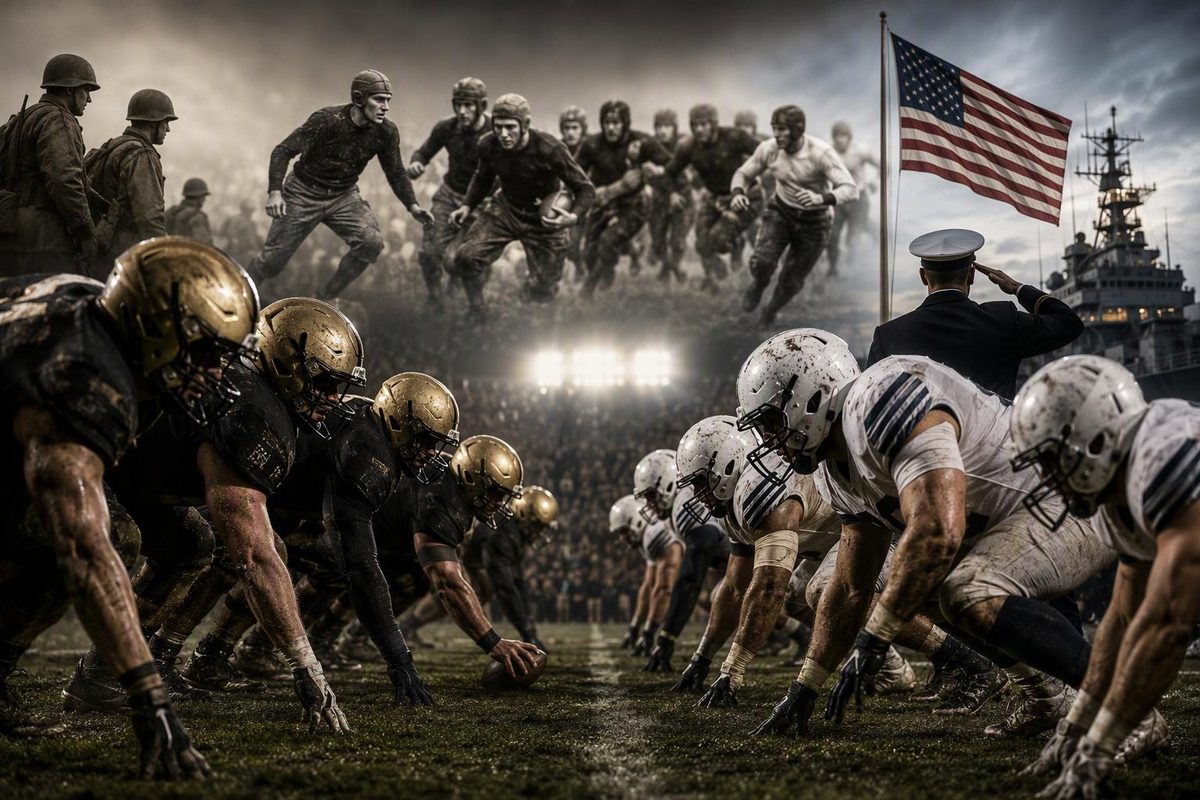
Trace Army–Navy football from its 1890 debut through interruptions, wartime showdowns, instant replay and the series record through 2025.
In 1890, each of West Point’s 271 cadets contributed 52 cents toward bringing Navy’s football team to campus. Cadet Dennis Mahan Michie had helped persuade academy authorities to accept the challenge; now the Corps was paying half the visitors’ travel expenses. On November 29, 1890, Navy defeated Army 24–0 on the Plain at West Point—the first game in a college football rivalry between the U.S. Military Academy and U.S. Naval Academy that would outlast several interruptions. The Army’s history of the first game documents both the collection and the contest.
Army and Navy have played every year since 1930. Through their December 2025 meeting, Navy led the series 64–55, with seven ties, across 126 games. West Point’s rivalry history establishes the annual run; the Naval History and Heritage Command’s results provide the record.
Michie’s challenge and Army’s first victory
Navy arrived with an established football program; Army was starting one. Michie served as captain, coach, trainer and business manager, gathering volunteers from the Corps. According to the Army’s account, only three of his players had previous experience, and practice opportunities were limited.
The defeat prompted better preparation. Lieutenant Denny Tate, the officer responsible for football, persuaded Harry Williams, a teacher in nearby Newburgh, to coach the cadets twice a week. Army traveled to Annapolis in 1891 and won 32–16. Both teams attended a dance at the Navy boathouse afterward, where Michie and Navy quarterback Worth Bagley congratulated each other. Both men later died in the Spanish-American War in 1898. The Army’s institutional history connects those early games with the players’ subsequent service.
For the sport’s broader chronology, see our history of American football.
Interruptions—and a Philadelphia home
The rivalry was not annual from the beginning. No games were played from 1894 through 1898. A frequently repeated explanation involves an argument between senior officers that nearly became a duel; the Army’s own summary introduces that account as “It’s said,” rather than presenting it as firmly established fact.
Later interruptions had clearer causes:
- 1909: Army canceled its remaining games after Cadet Eugene Byrne died from an injury suffered against Harvard.
- 1917–1918: The War Department ordered the games canceled during World War I.
- 1928–1929: The academies could not agree on player eligibility standards.
Together with the five-year early suspension, those breaks account for ten years without a game. The uninterrupted annual series began in 1930. The Army’s historical summary records the gaps and their explanations.
When play resumed in 1899, the teams met at Franklin Field in Philadelphia, where Army won 17–5. Philadelphia offered neutral ground roughly between the academies and became the rivalry’s most frequent host. Its principal venues followed a clear sequence: Franklin Field, Municipal Stadium—later renamed John F. Kennedy Stadium—Veterans Stadium and Lincoln Financial Field. The Philadelphia city-archives history explains the neutral-site choice; the official game-by-game record establishes the stadium sequence.
Philadelphia never had an exclusive claim. The 1926 game helped formally dedicate Chicago’s Soldier Field to Americans who served in World War I and ended 21–21. In 1983, the rivalry traveled to the Rose Bowl in Pasadena, where Navy won 42–13. Army’s venue history and Navy’s results archive document those departures.
When Army–Navy shaped the national title race
In 1944 and 1945, Army entered the game ranked No. 1 and Navy No. 2. Army won both meetings: 23–7 in Baltimore in 1944 and 32–13 in Philadelphia in 1945. These were contests between the country’s leading teams, not simply rivalry games given prominence by military tradition. The Army’s historical summary records the rankings and victories.
The 1944 matchup also served the wartime home front. Tickets were tied to war-bond purchases, and the event raised more than $58.6 million, according to Military.com’s retrospective. Army’s Doc Blanchard and Glenn Davis scored fourth-quarter touchdowns to secure the victory.
The rivalry’s mid-century stature is also visible in its Heisman winners: Army’s Blanchard (1945), Davis (1946) and Pete Dawkins (1958), and Navy’s Joe Bellino (1960) and Roger Staubach (1963). The Heisman Trophy’s rivalry history records all five and their performances against the other academy.
The 1963 game changed football television
Heisman winner Roger Staubach led Navy to a 21–15 victory over Army on December 7, 1963. But a television innovation gave that game significance beyond its result.
CBS director Tony Verna used videotape equipment to replay Army quarterback Rollie Stichweh’s fourth-quarter touchdown during the broadcast. Announcer Lindsey Nelson explained that Army had not scored again. Technical difficulties limited the experiment to that one replay, but it marked the debut of instant replay on the Army–Navy telecast. This was a broadcast innovation, not an officiating review system. The NCAA’s account describes Verna’s equipment, the play and the explanation to viewers.
Modern milestones and the meaning of “sing second”
Navy established the rivalry’s longest winning streak with 14 consecutive victories from 2002 through 2015. Army ended it with a 21–17 win in Baltimore in 2016, as documented in Navy’s historical game notes.
In 2022, Army won 20–17 in double overtime, the first overtime game in series history. Quinn Maretzki’s 39-yard field goal ended it after Army recovered a Navy fumble near the goal line. West Point’s game account records the finish.
The latest completed meeting, on December 13, 2025, was a 17–16 Navy victory at Baltimore’s M&T Bank Stadium. Navy Athletics’ results and the Naval History and Heritage Command agree on the result.
The game also concludes the season’s three-academy Commander-in-Chief’s Trophy competition, which includes Air Force. Its most revealing ceremony, however, comes after the final whistle: both teams gather for both alma maters, with the losing academy’s sung first and the winner’s second. That is why winning means getting to “sing second”—a competitive reward within a shared ceremony of respect. West Point’s account of the traditions explains both the trophy series and the singing order.