
Why the Ice Bowl Still Holds the Coldest Game Record
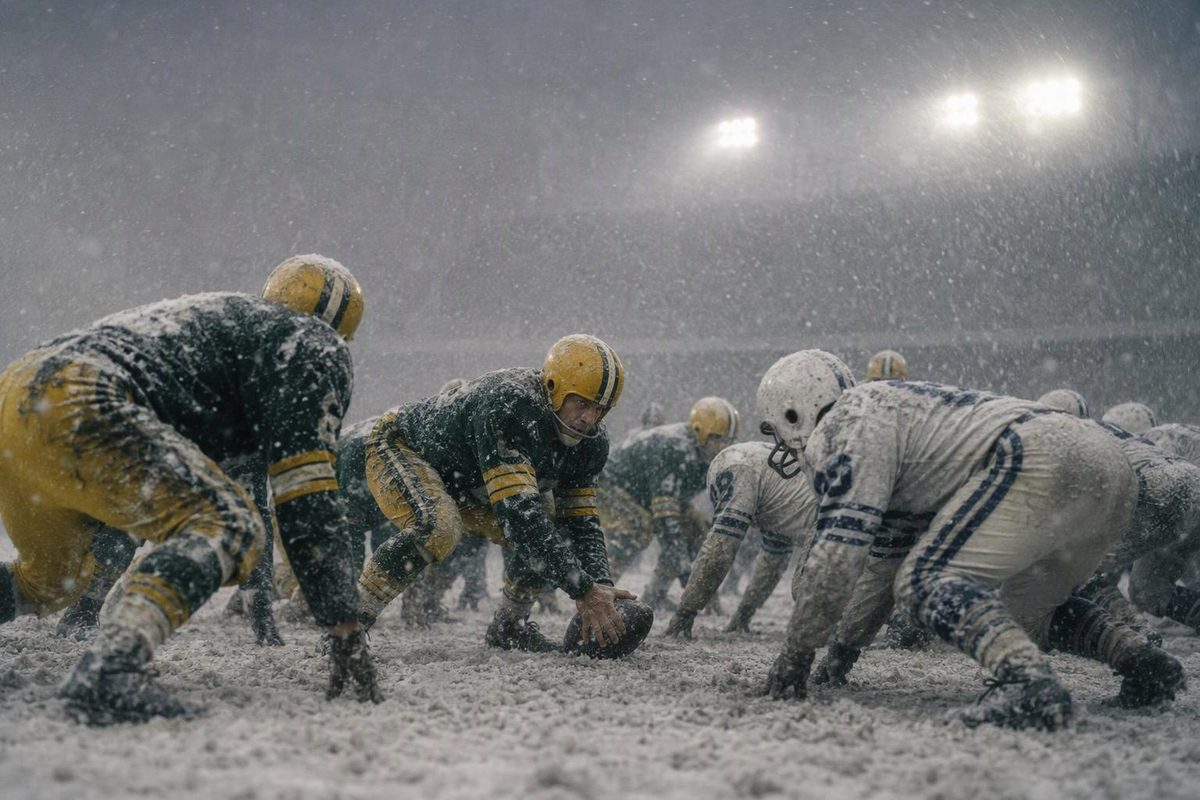
Compare the Ice Bowl’s −13°F kickoff with the Freezer Bowl and other frigid NFL playoff games, with wind-chill caveats and the story of Starr’s winning sneak.
The coldest game in NFL history by kickoff air temperature was the Ice Bowl, Green Bay’s 21–17 victory over Dallas at Lambeau Field on December 31, 1967. The temperature at kickoff was −13°F, according to the National Weather Service’s reconstruction. Cincinnati’s Freezer Bowl has a competing reputation because of its historically reported wind chill, but its recorded air temperature was warmer, at −9°F.
The distinction is the key to the record. Air temperature measures how cold the air actually was; wind chill describes the effect of wind and cold on exposed skin. Those measurements answer different questions, and the formula used to calculate wind chill has changed. For a consistent comparison of the games below, use kickoff air temperature.
Choose air temperature or wind chill to see which comparison the evidence supports.
Compare The Cold-Weather Records
Coldest kickoff: Ice Bowl, −13°F.The Freezer Bowl was four degrees warmer at −9°F. Air temperature gives the consistent comparison.
| Game | Kickoff Air | Wind Chill |
|---|---|---|
| Ice BowlDec. 31, 1967 | −13°F | −36°FNewer index |
| Freezer BowlJan. 10, 1982 | −9°F | −59°FHistorical report |
| Seahawks–VikingsJan. 10, 2016 | −6°F | −25°FReported |
| Giants–PackersJan. 20, 2008 | −4°F | —Not supplied |
| Dolphins–ChiefsJan. 13, 2024 | −4°F | −27°FReported |
Wind-Chill Methods And Caveats
The NFL gallery lists the Ice Bowl’s historical wind chill as −48°F. The National Weather Service reconstruction gives −36°F using the newer index, introduced for winter 2001–02.
The Freezer Bowl’s −59°F is historically reported. These sources do not supply a uniform newer-index reconstruction for all five games, so this table cannot establish a comparable wind-chill ranking. Wind chill describes exposed-skin heat loss, not actual air temperature.
Sources: NWS Ice Bowl reconstruction and wind-chill guidance; NFL cold-weather gallery; AP game report via CBS Sports for the 2024 game.
The Ice Bowl Was Coldest By Kickoff Temperature
The NFL’s cold-weather gallery lists the Ice Bowl at −13°F and the Freezer Bowl at −9°F. On that measure, Green Bay’s championship game was four degrees colder. The difference is straightforward because both figures describe air temperature, rather than a calculated equivalent that incorporates wind.
“Coldest game” needs that qualification. A temperature recorded before kickoff, the lowest reading during the afternoon and a wind-chill estimate are not interchangeable. The Ice Bowl’s record is specifically a kickoff air-temperature record. Its weather history also contains colder readings, but those do not replace the kickoff figure when comparing it with other games.
The National Weather Service reconstruction places Green Bay at −16°F at 9 a.m. on game day. During play, the temperature ranged from −12°F to −14°F. Those observations show that the −13°F kickoff reading was part of a sustained period of severe cold, not an isolated number surrounded by much milder conditions.
They also explain why some accounts of the same afternoon can contain different temperatures without necessarily contradicting one another. A morning observation and a kickoff observation describe different moments. The record comparison should keep the measurement and the moment together: −13°F at kickoff, not simply the lowest number associated with the day.
An Arctic Front Turned The Championship Into The Ice Bowl
Green Bay had reached 20°F the day before the championship. An Arctic front swept through shortly before midnight, and by the following morning the temperature had dropped sharply. The change left the Packers and Cowboys playing their title game in conditions far more severe than the previous day’s weather.
The National Weather Service reports that officials had to shout their signals because metal whistles could stick to their lips. Several players were treated for frostbite, and a spectator died of exposure. Nearly 51,000 people attended. Those details establish the human consequences of the weather more clearly than the nickname alone: the cold affected players, officials and spectators, and it could be fatal.
The whistle problem is particularly revealing. A championship game still required officials to communicate decisions, but an ordinary piece of equipment became unsafe to use in the usual way. The weather was not just a backdrop to the action. It altered how the game could be administered.
The attendance figure belongs beside the exposure report, rather than serving only as a measure of the occasion’s popularity. Nearly 51,000 spectators were present during an afternoon when temperatures remained below zero. The historical account records both the scale of the crowd and the danger of the conditions; neither should disappear from a retelling centered on the winning touchdown.
The temperature record and the game’s dramatic finish are separate reasons for its place in football history. Green Bay would hold the coldest-kickoff distinction regardless of the final score. The late comeback made that record-setting afternoon a championship story as well as a weather record.
Starr’s Final Drive Ended With A One-Yard Decision
Green Bay built a 14–0 lead, but Dallas answered with 17 consecutive points. With 4:50 remaining, the Packers took possession at their own 32-yard line, trailing 17–14. The Packers’ game recap places the final drive in that setting: Green Bay had to recover a lead it had lost, rather than merely protect an early advantage.
Starr moved the offense downfield, but two attempts near the goal line failed to produce the winning touchdown. With 16 seconds remaining, the Packers faced third-and-goal from inside the Dallas one-yard line. They had no timeouts.
That combination made the next play decisive. Green Bay was close enough to win with a touchdown, but the remaining time left little room for a failed attempt followed by a reset. The distance to the goal line was short; the margin for handling the clock was also short.
Center Ken Bowman and guard Jerry Kramer blocked Cowboys tackle Jethro Pugh, creating the opening for Starr’s quarterback sneak. Starr crossed the goal line with 13 seconds left, and the extra point made the score 21–17. The NFL’s account of the decisive play identifies the blocking that made the finish possible.
Remembering only Starr’s sneak can compress the ending too far. The Packers first had to move from their own 32 into scoring position, then overcome the failed goal-line attempts. The winning play joined the quarterback’s finish to Bowman and Kramer’s work at the line. It was the last step in a drive, not a touchdown opportunity that appeared without a buildup.
The final score also conceals the sequence that gave the afternoon its tension: a two-touchdown Green Bay lead, a Dallas comeback and then a last-minute reversal. That sequence helps explain why the Ice Bowl remains memorable beyond the thermometer reading.
The Ice Bowl Was An NFL Championship, Not A Super Bowl
The Ice Bowl was the NFL Championship Game. It was not an NFC Championship Game, and it was not a Super Bowl. That distinction matters because the game took place during the transition between the older league structure and the merged NFL.
The NFL and AFL had agreed to merge, but they remained separate leagues until 1970. Green Bay’s victory over Dallas settled the NFL championship. The Packers then faced the AFL’s Oakland Raiders in Super Bowl II and won, completing their third consecutive championship season. The Packers’ historical account explains that merger-era sequence.
Calling the Ice Bowl an NFC Championship applies a later competition label to an earlier game. Calling it a Super Bowl collapses two separate games into one. The accurate description preserves both steps: Green Bay beat Dallas for the NFL title, then beat Oakland in Super Bowl II.
This is why a list of the coldest NFL games can include the Ice Bowl without making it a coldest-Super-Bowl claim. “NFL game” describes the broader record being compared here; “Super Bowl” identifies a specific championship event. The Ice Bowl belongs in NFL championship history, but its precise place in that history depends on retaining the original title-game designation.
The Freezer Bowl’s Claim Comes From Wind Chill
The Bengals beat the San Diego Chargers 27–7 at Riverfront Stadium on January 10, 1982, in the AFC Championship Game for the 1981 season. The Freezer Bowl’s recorded air temperature was −9°F, and its historically reported wind chill was −59°F.
Cincinnati quarterback Ken Anderson completed 16 of 22 passes for 161 yards and two touchdowns, sending the Bengals to their first Super Bowl. Coach Forrest Gregg had played right tackle for Green Bay in the Ice Bowl, linking the two games through a participant who experienced one as a player and the other as a coach. Those details come from the Bengals’ retrospective.
The Freezer Bowl therefore has a substantial claim to prominence in any account of extreme NFL weather. Its wind-chill figure was lower than the historically reported −48°F associated with the Ice Bowl. But that does not make Cincinnati’s air temperature lower, and it does not justify treating every published wind-chill number as if it came from the same calculation.
The careful description is that the Freezer Bowl was warmer by recorded air temperature but had the more severe historically reported wind chill of these two games. That wording preserves the evidence behind its reputation without displacing the Ice Bowl’s kickoff-temperature record.
Anderson’s passing line is another reason not to reduce the Freezer Bowl to a weather statistic. Cincinnati won a conference championship by 20 points, with its quarterback completing 16 passes despite the conditions. The weather comparison explains the nickname; the game result explains the stakes.
Old And Modern Wind-Chill Figures Need Separate Labels
The National Weather Service implemented a revised wind-chill index for the 2001–02 winter season. That change matters when comparing a game played in 1967 or 1982 with a modern playoff game.
For the Ice Bowl, the NFL gallery gives a wind chill of −48°F. The National Weather Service reconstruction instead gives a kickoff wind chill of −36°F under the newer index. These are not two competing air-temperature readings. They are wind-chill values calculated under different systems.
The National Weather Service’s explanation of wind chill defines it in terms of heat loss from exposed skin caused by wind and cold. It does not turn the measured air temperature into a different actual temperature. The Ice Bowl’s −13°F kickoff reading remains −13°F whether an account pairs it with the old or newer wind-chill figure.
A defensible wind-chill ranking would require comparable calculations for the games being ranked. The evidence here supplies a newer-index reconstruction for the Ice Bowl, but not an equivalent reconstruction for every other game. It therefore does not establish a uniform modern-index ranking across the full comparison.
The Freezer Bowl’s −59°F should remain labeled historically reported. Likewise, the Ice Bowl’s −48°F should not be placed beside its newer −36°F estimate without explaining the difference. Using only the more dramatic figure would make the story simpler, but the comparison less reliable.
Later Playoff Games Did Not Break The Kickoff Record
The other notably cold games in this comparison remained warmer at kickoff than both the Ice Bowl and Freezer Bowl.
| Game | Date | Kickoff Air |
|---|---|---|
| Packers–Cowboys, Ice Bowl | Dec. 31, 1967 | −13°F |
| Bengals–Chargers, Freezer Bowl | Jan. 10, 1982 | −9°F |
| Seahawks at Vikings | Jan. 10, 2016 | −6°F |
| Giants at Packers | Jan. 20, 2008 | −4°F |
| Dolphins at Chiefs | Jan. 13, 2024 | −4°F |
Seattle’s wild-card game at Minnesota began at −6°F, with a reported wind chill of −25°F. The Giants–Packers NFC Championship Game began at −4°F. Both kickoff temperatures appear in the NFL’s cold-weather gallery.
Miami’s playoff visit to Kansas City also began at −4°F, with a wind chill of −27°F, according to the AP game report carried by CBS Sports. It tied the 2008 game’s air temperature, placing the two games joint fourth behind the Ice Bowl, Freezer Bowl and Seattle–Minnesota game.
Kansas City’s kickoff was nine degrees warmer than the Ice Bowl’s. That comparison does not make the 2024 conditions mild: it places another dangerously cold playoff game against the record using the same measurement.
The answer remains the Ice Bowl at −13°F when “coldest” means kickoff air temperature. The Freezer Bowl belongs alongside it when discussing historically reported wind chill, with the calculation caveat attached. Keeping those measures separate resolves the apparent conflict without erasing either game’s exceptional conditions.