
Who Was the Best Running Back in NFL History?
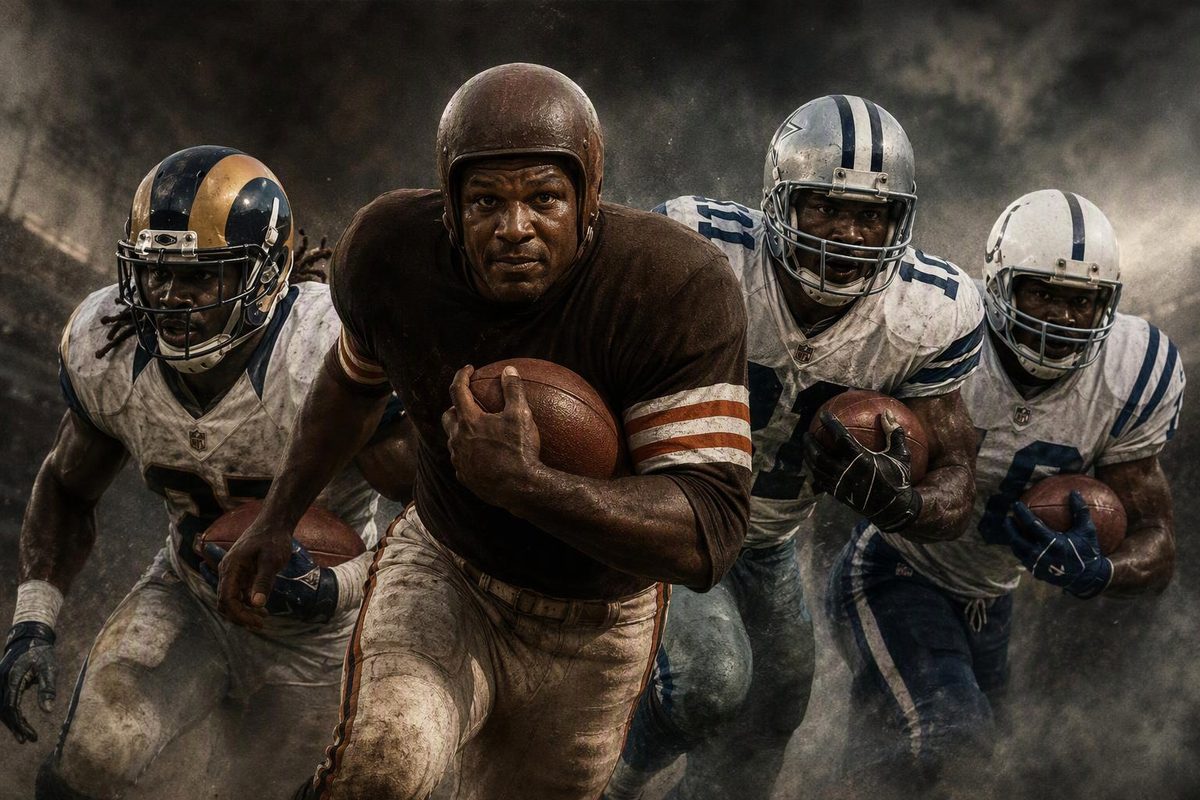
Jim Brown leads our ranking of the greatest NFL running backs, with the cases for Payton, Sanders and Smith—and the era differences that matter.
Jim Brown left football at 30 without giving anyone a decline phase to judge. His final NFL season was 1965; he retired the following summer after leading the league in rushing eight times in nine seasons. That extraordinary concentration of dominance makes Brown our choice as the best running back in NFL history. NFL career retrospective
It is a judgment, not an official record. Walter Payton has a compelling all-around case, Barry Sanders a remarkable combination of elusiveness and sustained production, and Emmitt Smith the strongest career rushing résumé. This ranking weighs dominance against contemporaries, sustained excellence, rushing and receiving contributions, and scoring. Championships supply context rather than a shortcut: a running back does not win them alone. It is a qualitative comparison, not a formula that adjusts every statistic for era.
The numbered selections focus on players whose NFL playing careers have ended, rather than active backs. Career yardage figures below are regular-season totals, with postseason achievements identified separately.
1. Jim Brown: the strongest overall case
Brown accumulated 12,312 rushing yards in 118 games for Cleveland, averaging 104.3 yards per game and 5.2 per carry. He never missed a game during his nine-season career. Those rates explain why career yardage alone understates his case. Pro Football Hall of Fame career summary
His eight rushing titles are especially persuasive because they compare him with players operating under the same conditions. In 1958, he gained 1,527 yards and scored 17 rushing touchdowns in a 12-game season. He was already rewriting the record book without the additional opportunities later runners received. NFL All-Time Team profile
The limitation is obvious: nine seasons cannot establish the same longevity as Smith’s career. But if “best” means the most consistently dominant runner relative to his league, Brown has the clearest claim.
2. Walter Payton: the all-around alternative
Payton’s case combines production, versatility and durability. When he retired after the 1987 season, he held the NFL career records for rushing yards, rushing touchdowns and yards from scrimmage. His totals included 16,726 rushing yards and 4,538 receiving yards; he also threw eight touchdown passes.
More revealing than a single spectacular season are his 10 seasons with at least 1,500 yards from scrimmage. Payton contributed as both runner and receiver over a long period, and his 1977 MVP award demonstrates that his résumé was not merely accumulated through persistence. Hall of Fame profile
Payton ranks second here because that breadth and longevity bring him closest to Brown’s overall case. Readers who give greater weight to a complete offensive role can reasonably put him first.
3. Barry Sanders: elusiveness backed by sustained production
Sanders rushed for more than 1,000 yards in every one of his 10 seasons with Detroit. His defining campaign came in 1997: 2,053 rushing yards, another 305 receiving yards, and 14 consecutive regular-season games above 100 yards rushing. Hall of Fame profile
His career total of 15,269 rushing yards gives statistical substance to the memories of sudden cuts and missed tackles. Hall of Fame career rushing table
Sanders belongs near the top because his spectacular style was not an occasional highlight. It produced a decade of excellence. Like Brown, however, he retired before a longer career could answer the longevity question.
4. Emmitt Smith: the greatest career rushing résumé
Smith’s 18,355 rushing yards and 164 rushing touchdowns are the central facts of his argument. But describing him only as a compiler misses his peak: he won four rushing titles, earned the 1993 NFL MVP award and was first-team All-Pro in four consecutive seasons from 1992 through 1995.
He also helped Dallas win three Super Bowls and earned Super Bowl XXVIII MVP honors. Those achievements complement his individual production; they do not replace it. Hall of Fame profile
Smith ranks fourth under a framework that favors Brown’s relative dominance, Payton’s breadth and Sanders’ rushing excellence. If “greatest” means the most accomplished career runner, Smith has the strongest case. For the numerical comparison, see our career rushing leaders and record history.
5. Marshall Faulk: receiving changes the comparison
Faulk makes the strongest argument against treating rushing yards as a complete measure of a running back. In 1999, his first season with the St. Louis Rams, he exceeded 1,000 yards in both rushing and receiving and produced a then-record 2,429 yards from scrimmage.
He followed with the 2000 MVP award and won Offensive Player of the Year in three consecutive seasons, 1999–2001. His 767 career receptions for 6,875 yards explain his place here: evaluating only handoffs would discard a major part of his value. Hall of Fame profile
6. LaDainian Tomlinson: scoring and versatility
Tomlinson’s 2006 MVP season brought 1,815 rushing yards, 28 rushing touchdowns and three receiving touchdowns. His 31 touchdowns established a new single-season NFL record.
That scoring peak sits within a substantial two-way résumé: 13,684 career rushing yards and 624 receptions. In 2003 alone, he caught 100 passes. Hall of Fame profile
Faulk receives the edge here for his sustained rushing-and-receiving peak, but Tomlinson is a strong choice for readers emphasizing scoring.
7. Eric Dickerson: extraordinary production from the start
Dickerson rushed for 1,808 yards as a rookie in 1983, then 2,105 in 1984. He reached 10,000 career rushing yards in just 91 games and finished with 13,259. Hall of Fame profile
His early production makes him indispensable to any discussion of the greatest pure runners. His case here rests more heavily on rushing than the broader receiving contributions that lift Faulk and Tomlinson. Our single-season rushing records history examines those landmark seasons separately from career greatness.
8. Adrian Peterson: a peak worthy of the top tier
Peterson’s 2012 season yielded 2,097 rushing yards and the Associated Press NFL MVP award, following a severe knee injury in December 2011. That was not an isolated achievement in a short career: he finished with 14,918 rushing yards. Contemporary NFL award report, Hall of Fame career rushing table
Peterson earns this place through the combination of a remarkable rushing peak and substantial career production. The players above him offer stronger cases under this ranking’s combined measures of relative dominance, sustained excellence and offensive breadth.
Why the era still matters
A season total is not a level playing field. O.J. Simpson gained 2,003 rushing yards in 1973, averaging 143.1 per game across Buffalo’s 14-game season. Dickerson’s 2,105 came during the Rams’ 16-game 1984 schedule. The latter total is larger; the former pace is higher. Neither calculation alone identifies the better career. Simpson profile, 1973 standings, 1984 standings
Earlier players also deserve more than dismissal by career yardage. Steve Van Buren won four NFL rushing titles and supplied the offensive punch in Philadelphia’s 1948 and 1949 championship victories. Marion Motley led the NFL in rushing in 1950, but his earlier Cleveland achievements belonged to the AAFC, not the NFL; his combined professional totals must be labeled accordingly. Van Buren profile, Motley profile
That is why Brown’s eight rushing titles carry so much weight in this ranking. They measure repeated superiority within his own league and era—without pretending that a longer schedule or a larger career total settles the question.