
The Best Cornerbacks in NFL History, Ranked Across Eras
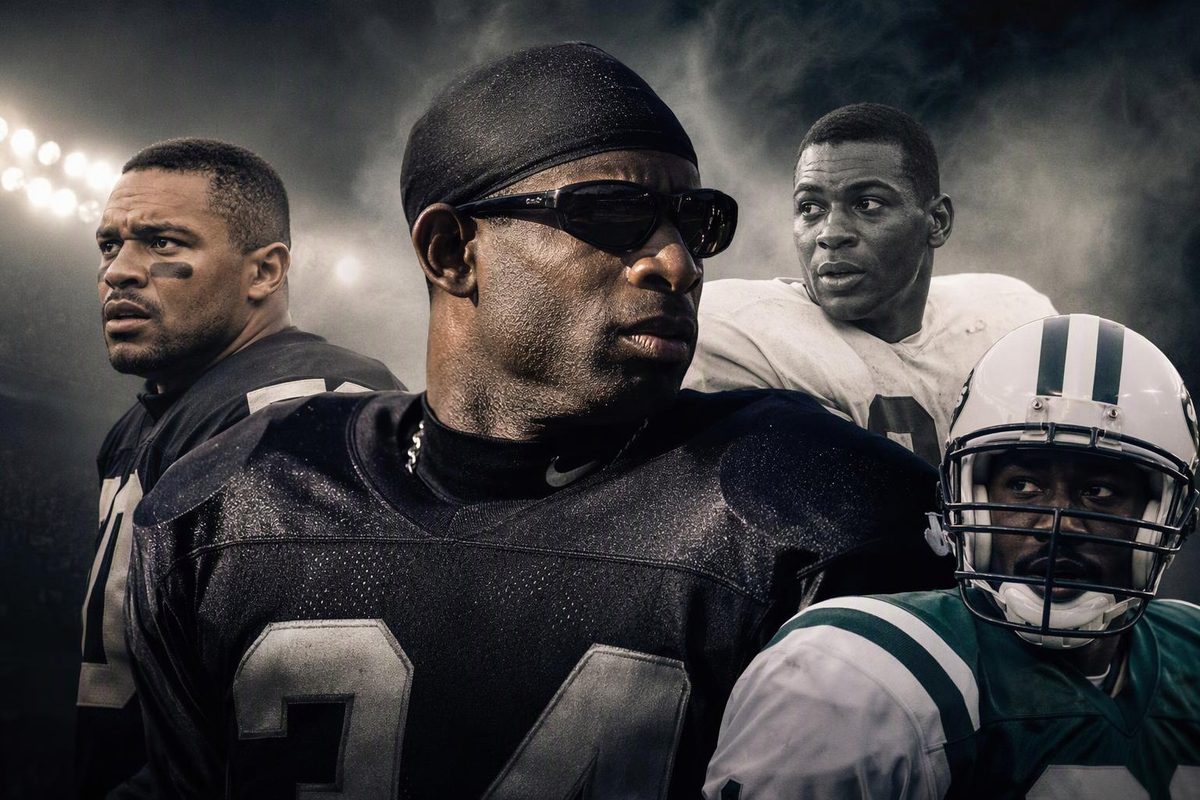
Deion Sanders leads our top 10 NFL cornerbacks, with the cases for Rod Woodson, Night Train Lane and Revis—and the rules that shape comparisons.
Deion Sanders made throwing at him dangerous—and throwing elsewhere attractive. In ESPN’s 2022 poll of 50 experts, reporters and analysts, he received 32 votes as the greatest cornerback ever. The accompanying assessments emphasized not just his interceptions but the passes quarterbacks chose not to throw toward him. ESPN’s poll
That distinction is at the heart of this ranking: the best cornerback is not necessarily the one with the most interceptions. Sanders is our No. 1, ahead of Rod Woodson and Dick “Night Train” Lane. Here is the full ranking and the historical case for each selection.
How we compare cornerbacks across eras
This is an editorial judgment, not an official NFL ranking. Coverage at a player’s peak carries the most weight, followed by sustained excellence, tackling and other defensive contributions. Contemporary honors help establish standing within an era; return-game achievements are secondary.
The rules matter. In 1978, the NFL restricted contact with receivers beyond five yards from the line of scrimmage while allowing contact within that area. That divides the careers of some early greats from those who played entirely under the tighter restrictions. We judge players against their own conditions rather than assuming their techniques could transfer unchanged. Pro Football Hall of Fame’s 1978 chronology
Players who later moved to safety remain eligible for substantial elite careers at cornerback, but their safety statistics are not treated as cornerback production.
1. Deion Sanders
Sanders gets the top position because coverage—not all-around defensive versatility—is the central task. His Hall of Fame biography describes him as a shutdown corner, while his 53 career interceptions and nine interception-return touchdowns demonstrate the punishment when quarterbacks challenged him.
His 1994 season with San Francisco supplied the clearest peak: three interception-return touchdowns and the NFL Defensive Player of the Year award. He then started in consecutive Super Bowl victories for the 49ers and Cowboys. The combination of coverage reputation and decisive defensive plays makes his case stronger than interception volume alone. Hall of Fame biography
2. Rod Woodson
Woodson is our strongest alternative if the definition of greatness gives more weight to a cornerback’s entire defensive contribution. In his 1993 Defensive Player of the Year season, he recorded eight interceptions, 28 passes defensed, two sacks and a team-high 79 solo tackles. That is a much broader case than simply catching errant passes. Hall of Fame biography
His eventual 71 interceptions covered both cornerback and safety work; the Ravens’ account documents his later position change. His ranking rests primarily on his Pittsburgh excellence at corner, not on assigning his whole career total to that position. Ravens’ career retrospective
3. Dick “Night Train” Lane
Lane’s 1952 rookie season—14 interceptions in a 12-game schedule—is the spectacular starting point, not the whole argument. He combined speed and agility with devastating tackling, then earned first- or second-team All-NFL recognition every year from 1954 through 1963.
That sustained standing is why he ranks above most later stars here. His case encompasses a decade of excellence, rather than one extraordinary record. It also belongs to an earlier contact environment, which must remain part of the comparison. Hall of Fame biography
4. Mel Blount
Blount’s physical coverage made him a defining cornerback of the 1970s Steelers. The Hall of Fame describes him as equally effective in zone and man-to-man defense, with the size and speed to overpower receivers in bump-and-run coverage.
More important for an era-aware ranking, he adapted when the rules restricted that approach. His 1975 Defensive Player of the Year award established his peak; All-Pro acclaim in 1981 showed his success continued after the 1978 changes. That adaptability keeps him near the top, rather than confined to a story about a vanished style of play. Hall of Fame biography
5. Darrelle Revis
Revis has a compelling case to move higher if peak coverage is virtually the only criterion. In 2009, he recorded six interceptions and 31 passes defensed while helping the Jets finish with the league’s top-ranked pass defense. He placed second in AP Defensive Player of the Year voting.
Four first-team All-Pro selections—2009 through 2011, then 2014—show that his reputation was not built on one season. His 29 career interceptions also illustrate why a turnover leaderboard cannot adequately rank cornerbacks. We place him fifth because the players above him offer stronger combinations of peak and sustained achievement. Hall of Fame biography
6. Mike Haynes
Haynes offers excellence on both sides of the 1978 rule change. His speed, quickness and range earned nine Pro Bowl invitations, beginning with his rookie season in New England. His Hall of Fame biography lists All-Pro selections in 1977, 1978, 1982, 1984 and 1985.
After joining the Los Angeles Raiders during the 1983 season, he started in their Super Bowl XVIII victory and intercepted a pass. We favor the sustained coverage case over any single signature play: Haynes was an elite defender in two organizations and across changing conditions. Hall of Fame biography
7. Charles Woodson
Charles Woodson’s argument is versatility. His Hall of Fame biography emphasizes cover-corner agility alongside strength and a willingness to tackle. In 2009, he led the NFL with nine interceptions, returned three for touchdowns and won AP Defensive Player of the Year.
We put him ahead of Bailey because this ranking rewards defensive disruption beyond coverage. But his final totals require care: the 65 interceptions span an 18-year career that included later work at free safety, documented by the Raiders. Those are not 65 interceptions solely as a cornerback. Hall of Fame biography · Raiders retrospective
8. Champ Bailey
Bailey’s case is sustained high-level cornerback play. He started all but three of his 215 career games, earned 12 Pro Bowl selections and made the NFL’s All-Decade Team of the 2000s. His 2006 season added an NFL-leading 10 interceptions to an established lockdown reputation.
Readers placing greater weight on long-term coverage excellence could reasonably move him above Charles Woodson. Here, Woodson’s broader defensive contributions narrowly prevail; Bailey’s durability and coverage standing keep him firmly in the top 10. Hall of Fame biography
9. Willie Brown
Brown’s career began with Denver in the AFL in 1963 and continued with Oakland through 1978. His seven all-league selections—three All-AFL and four All-NFL—establish excellence before and after the merger. His five AFL All-Star appearances should not be relabeled NFL Pro Bowls; he also made four Pro Bowls.
The 75-yard interception-return touchdown in Super Bowl XI remains his signature moment. His place here, however, rests on 16 seasons of accomplished cornerback play, not just that enduring highlight. His pre-merger AFL work belongs in the evaluation, with the league distinction intact. Hall of Fame biography
10. Darrell Green
Green supplies the strongest longevity argument on this list: 20 seasons with Washington, seven Pro Bowl selections and an interception in 19 consecutive seasons. The Hall of Fame also records his speed enduring as he played into his 40s.
His contribution was not merely survival. Late in the NFC Championship Game following the 1987 season, he broke up a fourth-down goal-line pass to Darrin Nelson to secure Washington’s victory. We rank him tenth because longevity does not outweigh the peaks above him, but his sustained effectiveness makes him much more than a durability selection. Hall of Fame biography
Why interception totals cannot settle the ranking
An interception records a successful play on a pass that was thrown. It cannot capture a quarterback abandoning a well-covered receiver, and it does not by itself explain coverage responsibility, tackling or defensive scheme.
That is why Revis can rank above players with far more interceptions, and why the Woodsons’ cornerback and safety work must be distinguished. For the separate statistical question, see our guide to the most interceptions in NFL history. This ranking answers who played the position best—not who accumulated the largest total.