
How Dave Nelson and Tubby Raymond Built the Delaware Wing-T
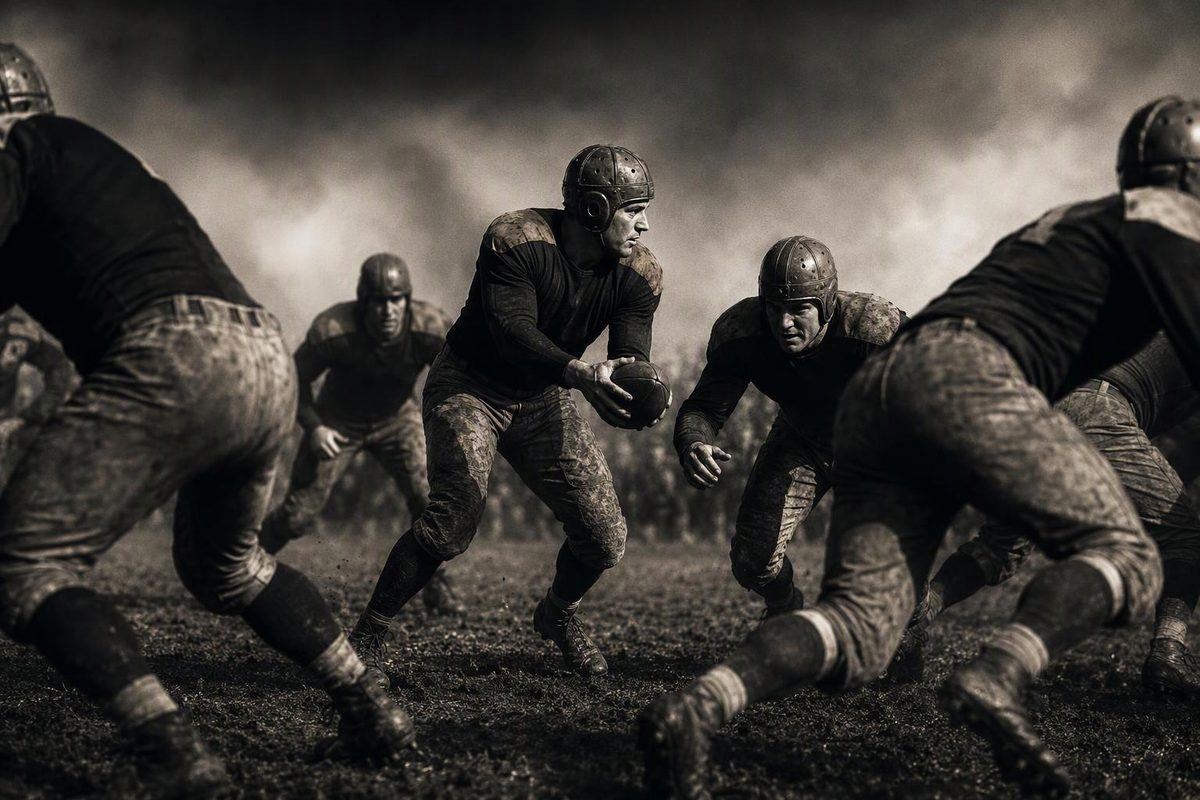
How Dave Nelson and Tubby Raymond made the Wing-T a system of motion, misdirection and complementary plays—and a Delaware signature.
A guard pulls. A wingback crosses the formation. The fullback drives toward the line. The quarterback carries out a fake—and several possible plays look alike for their first few steps.
That coordinated deception is the point of the Wing-T offense. It is not merely a formation with a wingback outside the tight end, but a system of related runs and play-action passes. Dave Nelson began developing it at Maine in 1949–50, then made Delaware its enduring home with Harold “Tubby” Raymond and their staffs.
What is the Wing-T offense?
A traditional Wing-T formation places the quarterback under center and the fullback behind him. A halfback commonly aligns as a wing just outside and behind the tight end, while another back sets deeper on the opposite side. A split end provides width. Alignments and terminology vary among teams, but the backfield is deliberately asymmetrical.
The formation combines characteristics associated with two older offenses:
- The T formation puts the quarterback under center, facilitating quick handoffs and ball fakes.
- The single-wing tradition contributes a wingback, motion, blocking angles and multiple rushing threats.
The name describes the formation’s shape, but not its full logic. Wing-T teams arrange plays in series. Several calls show the defense similar motion and backfield action before attacking different places.
The classic buck-sweep series illustrates the idea:
- Fullback trap: The fullback attacks inside, with a blocker trapping a defender allowed to cross the line.
- Buck sweep: Similar initial action sends a halfback outside behind pulling linemen.
- Waggle: The quarterback fakes the run action, moves away from it and has run-pass options.
The system has never required every team to use precisely the same playbook. Coaches have incorporated belly runs, options, counters, shotgun snaps and newer passing concepts. The connecting principle is that one play makes another more difficult to diagnose.
Dave Nelson began developing it at Maine
David M. Nelson played halfback at Michigan from 1939 through 1941 before beginning a coaching career interrupted by World War II service. After coaching at Hillsdale and assisting at Harvard, he became Maine’s head coach in 1949.
The University of Delaware’s archive says Nelson began developing the “Winged-T” during his 1949–50 tenure at Maine. The College Football Hall of Fame similarly credits him with starting the formation there and developing it further at Delaware.
Nelson brought the offense with him when he became Delaware’s head coach in 1951. Its design reflected more than a collection of fakes. His master’s thesis, A Study of the Factors Influencing the Success and Failure of Football Rushing Plays, analyzed games in detail. Historian Steven Johnson concluded that the research led Nelson to blocking principles that reduced the need for players to memorize a separate assignment for every play, according to the University of Delaware’s guide to the David M. Nelson papers.
That approach helps explain the system’s appeal. Linemen could apply blocking rules to the defensive front while backs repeated synchronized footwork. The offense could present a defense with several threats without becoming a collection of unrelated plays for the offense itself.
Nelson also put the system into print. With former Michigan teammate Forest Evashevski, he co-authored Scoring Power with the Winged-T Offense in 1957 and The Modern Winged-T Playbook in 1961. The Delaware archive says Evashevski used the formation at Iowa, which won the Rose Bowl in January 1957 and January 1959, and identifies Paul Dietzel, Frank Broyles, Ara Parseghian, Jim Owens and Eddie Robinson among the prominent college coaches who adopted it.
Why it became the Delaware Wing-T
The offense acquired its strongest geographic identity after Nelson moved to Newark. His Delaware teams won three Middle Atlantic Conference championships, and the 1963 team received the UPI small-college national championship. Nelson completed his head-coaching career with a 105-48-6 record, according to his College Football Hall of Fame biography.
Raymond ensured that the system outlasted Nelson’s coaching tenure. He arrived at Delaware in 1954, served for 12 seasons as an assistant under Nelson and became head coach in 1966. The University of Delaware calls Raymond one of the Wing-T’s innovators.
Over 36 seasons, Raymond went 300-119-3 and led Delaware to national titles in 1971, 1972 and 1979. He did not treat the offense as a museum piece: Delaware’s version became known for what the athletics department describes as “motion, misdirection and a unique personnel set-up.”
A fitting example came in Raymond’s final home game, against Richmond on Nov. 10, 2001. Halfback Butter Pressey scored the game’s only touchdown on what Delaware called a classic Wing-T counter. The Blue Hens won 10-6, giving Raymond his 300th career victory.
“Delaware Wing-T” therefore refers both to an offensive family and to the program that taught, refined and demonstrated it for decades. Nelson began the formation at Maine; Nelson and Raymond made Delaware its lasting institutional home.
Why the deception works
The Wing-T tries to give defenders conflicting information. A linebacker following a pulling lineman can be drawn toward a sweep while the ball goes inside. An edge defender reacting to a run fake can leave space for the quarterback’s rollout. Motion can change the formation immediately before the snap and force the defense to adjust without giving it time to substitute.
Three elements work together:
- Backfield action: Backs carry out fakes after the exchange, delaying identification of the ball carrier.
- Motion: A wingback can threaten a different gap or create a new blocking angle before the snap.
- Companion plays: Traps, sweeps, counters and play-action passes exploit different responses to a similar opening picture.
That is why stopping one signature run does not necessarily stop the offense. An adjustment that closes the buck sweep may expose the trap, counter or waggle paired with it.
The Wing-T’s historical importance lies in this architecture. Nelson did not simply draw a successful sweep; he organized an offense in which one play gave credibility to the next. Raymond’s Delaware teams carried that approach through the rest of the 20th century, turning a formation begun at Maine into one of American football’s most recognizable systems of misdirection.