
How George Blanda Played Until Just Short of 49
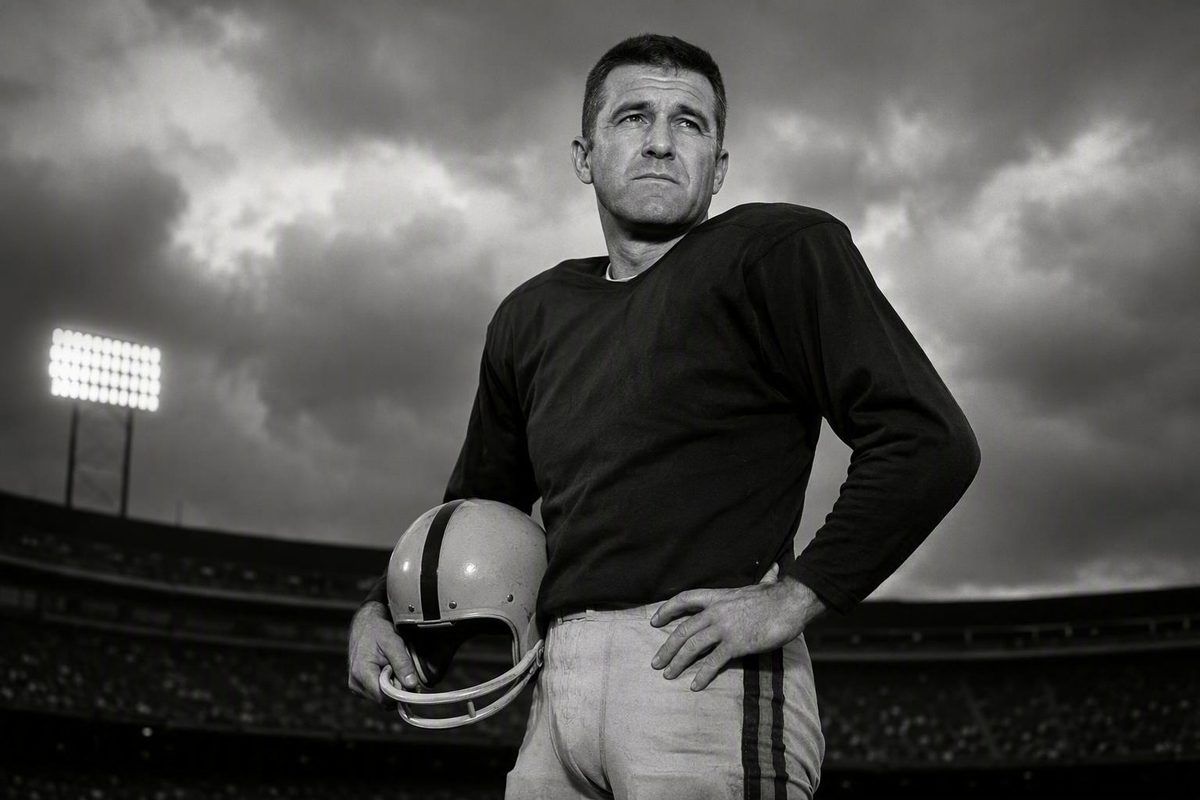
Blanda played his final NFL season at age 48, then retired shortly before his 49th birthday—clarifying why he did not play at 49.
George Blanda is the oldest player in NFL history according to the Pro Football Hall of Fame. The Hall lists the longtime quarterback and kicker in its age-48 category for his final season with the 1975 Oakland Raiders.
He appeared in 14 games that season and later retired before the 1976 season, approximately one month before his 49th birthday, according to Blanda’s Hall of Fame biography. He therefore played through age 48—not at age 49.
George Blanda is the oldest player in NFL history
The Hall of Fame’s “40 and Over Club” places Blanda above every other player in its historical table. Its classification supplies the clearest institutional basis for calling him the NFL’s oldest player.
| Fact | George Blanda |
|---|---|
| Listed age | 48 |
| Born | September 17, 1927 |
| Positions | Quarterback and kicker |
| Final season | 1975 |
| Final team | Oakland Raiders |
The distinction rests on the Hall’s age classification rather than on a universal definition covering every possible type of football longevity record. A player’s age, number of seasons, roster status and position-specific achievements are different measures.
Was Blanda 48 or 49 when his career ended?
Blanda played through age 48 and retired shortly before turning 49. Saying that he was “almost 49” when he retired is accurate; saying that he played at 49 is not.
The difference comes from separating his final playing season from his retirement. Born on September 17, 1927, Blanda completed his final season in 1975 and retired before the 1976 season, about one month short of his next birthday.
The Hall’s table organizes players into whole-number age categories. It does not state Blanda’s exact age in years and days on the date of his final appearance. The most precise formulation available from the Hall’s records is:
George Blanda played his final NFL season at age 48 and retired shortly before his 49th birthday.
That wording avoids treating his retirement age as his age during an actual game.
Why Blanda’s quarterback-kicker career matters
Blanda was both a quarterback and a kicker, and those two roles defined his unusual late-career value. Earlier in his career he carried substantial passing responsibilities. After Oakland acquired him when he was nearly 40, the Raiders used him as a contributing backup passer and dependable kicker.
His duties were not merely ceremonial. At age 43 in 1970, Blanda used late touchdown passes and field goals to help Oakland produce four wins and one tie during a five-game stretch. That season he also became the oldest quarterback to play in a title game, the Hall of Fame biography reports.
Blanda’s versatility helps explain his particular role with Oakland, but it should not be turned into a general rule that specialists necessarily enjoy longer careers. His longevity reflected his own circumstances and his continued usefulness in both the passing and kicking games.
The Hall credits Blanda with 26 professional-football seasons. That total spans NFL and AFL competition rather than 26 NFL seasons. The AFL gave him another opportunity to play with the Houston Oilers beginning in 1960, and he later joined Oakland before the AFL-NFL merger took effect.
How Blanda compares with Morten Andersen
Morten Andersen follows Blanda in the Hall of Fame’s table. Andersen is listed in the age-47 category for his final season with the 2007 Atlanta Falcons, while Blanda occupies the age-48 category for the 1975 Oakland Raiders.
| Player | Hall age category | Final season and team | Position |
|---|---|---|---|
| George Blanda | 48 | 1975 Oakland Raiders | Quarterback-kicker |
| Morten Andersen | 47 | 2007 Atlanta Falcons | Kicker |
This is a comparison of whole-number age bands, not a calculation of each player’s exact age on his final playing date. The Hall of Fame table also notes that Wade Wilson was active at age 40 without playing that season, illustrating why roster status should not automatically be treated as proof of game participation.
The table consequently supports the restrained conclusion that Blanda ranks first in its age-48 category and Andersen follows at 47. It does not provide the appearance-level information required to construct a precise ranking based on each player’s age during his final game.
Three longevity records that should not be confused
Being the oldest player is not the same as playing the greatest number of seasons. A quarterback-specific age achievement is narrower still.
| Longevity concept | What it measures | Blanda’s achievement |
|---|---|---|
| Oldest-player classification | Hall age category associated with the listed final season | Age-48 category |
| Career length | Number of professional seasons | 26 AFL and NFL seasons |
| Quarterback age milestone | Age during a specific quarterback achievement | Oldest quarterback to play in a title game in 1970 |
Age and season count answer different questions. Age depends on a birth date and the career point being measured, whereas season count records how many professional seasons a player completed. A long career does not by itself prove an oldest-player distinction.
The quarterback milestone must also remain specific. Blanda’s title-game achievement does not establish that he was the oldest quarterback in every context; it identifies a particular record tied to a particular type of game.
The precise conclusion is that the Pro Football Hall of Fame recognizes George Blanda as the NFL’s oldest player, placing him in its age-48 category after his 1975 season with Oakland. He retired just short of 49, while his 26-season professional career and title-game quarterback milestone represent separate forms of longevity.