
Dallas Cowboys Quarterbacks: From LeBaron to Prescott
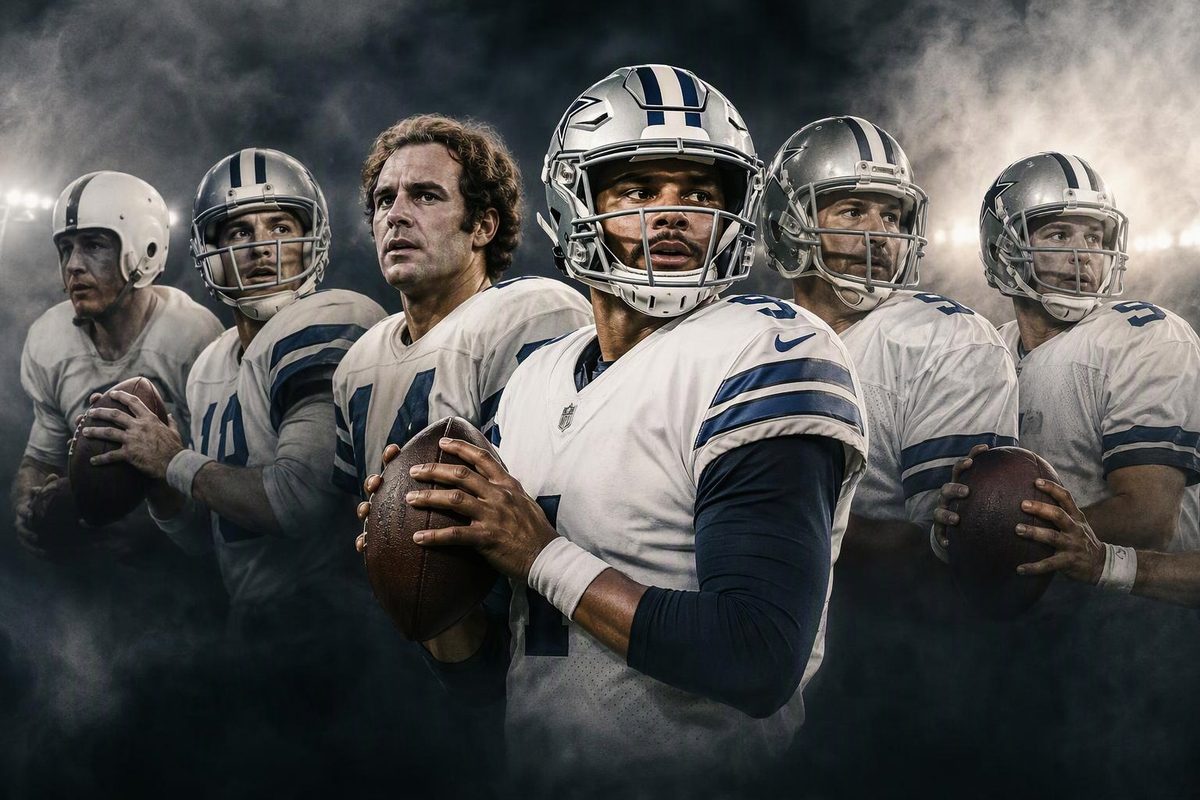
Trace Dallas Cowboys quarterback history from Eddie LeBaron to Dak Prescott, including Meredith, Staubach, White, Aikman and Romo.
Eddie LeBaron threw for 345 yards, three touchdowns and three interceptions in the Dallas Cowboys’ first regular-season game in 1960. Dallas lost to Pittsburgh, 35–28. The Cowboys’ account of LeBaron’s career identifies him—not Don Meredith—as their first starting quarterback.
Meredith helped make Dallas a contender. Roger Staubach and Troy Aikman quarterbacked its five Super Bowl victories. Tony Romo and Dak Prescott later moved the franchise’s passing records beyond the championship-era totals. The chronology below follows the principal quarterbacks and the transitions between them, rather than listing every reserve who appeared on a roster.
LeBaron and Meredith: the beginnings, 1960–1968
LeBaron played his final four NFL seasons with Dallas, from 1960 through 1963. He supplied experience to the expansion team while sharing time with Meredith, and earned a Pro Bowl selection in 1962. Meredith took over the starting job for good in 1963. Dallas’s LeBaron history documents that gradual handover.
By 1966, Meredith was leading a different kind of team. Dallas finished 10–3–1, and he threw for 2,805 yards and 24 touchdowns, both career highs. His partnership with speedy receiver Bob Hayes helped turn the Cowboys into a championship challenger. Meredith’s official Ring of Honor biography records those milestones.
Dallas lost the NFL Championship Game to Green Bay in consecutive seasons, 1966 and 1967—the second defeat coming in the Ice Bowl. These were NFL championship games, not Super Bowls: the winner advanced to face the AFL champion. Meredith retired after the 1968 season, leaving Craig Morton to inherit the main job.
Morton and Staubach: competition before the championships
Morton had spent four seasons behind Meredith before becoming Dallas’s principal starter in 1969. Staubach arrived that same year as an unusually old rookie: 27, following his Naval Academy career and military service. Their succession was not straightforward. Staubach actually started the 1969 opener because Morton had a broken finger, but Morton returned the following week. The Cowboys’ retrospective on Morton traces the competition.
Morton quarterbacked Dallas in its first Super Bowl appearance, the loss to Baltimore in Super Bowl V following the 1970 season. The competition continued into 1971: Tom Landry even alternated Morton and Staubach play by play in a loss at Chicago before committing to Staubach that November. Staubach subsequently led Dallas to victories in Super Bowls VI and XII, earning MVP honors in VI. The Hall of Fame’s Staubach biography credits him with four NFC championship victories and two Super Bowl wins during his years in command.
Even then, the job changed hands temporarily. A separated shoulder kept Staubach out for most of 1972. In the divisional playoff against San Francisco, he relieved Morton and threw two touchdown passes in the final 90 seconds of a 30–28 comeback win. He regained the starting role and held it through his final season in 1979, according to the Hall of Fame.
Staubach’s historical case rests on more than championships. He led the NFL in passer rating four times, and his career rating of 83.4 was the league’s best at the time he retired, according to the Hall of Fame.
Danny White: more than the man after Staubach
Danny White’s route to Dallas passed through another professional league. Drafted by the Cowboys in 1974, he instead played two seasons for Memphis in the World Football League. After that league folded, he joined Dallas in 1976, serving as punter and Staubach’s backup. The Cowboys’ interview with White explains that choice and his eventual succession.
White became the regular starter in 1980 and led Dallas to three consecutive NFC Championship Games, for the 1980–1982 seasons. None produced a Super Bowl appearance, but treating his tenure simply as a failed attempt to replace Staubach misses how competitive those teams remained. He finished his Dallas career with 21,959 passing yards and 155 touchdown passes.
The later Tom Landry years also included starts by Gary Hogeboom and Steve Pelluer, part of the less-settled stretch before Aikman’s arrival. Their contributions appear in Dallas’s career passing records.
Troy Aikman: the 1990s championship quarterback
Dallas selected Aikman first overall in the 1989 NFL Draft. His rookie season coincided with a 1–15 team record; by the 1992 season, the Cowboys were 13–3 and on their way to a Super Bowl championship. Aikman’s Hall of Fame biography charts that rebuilding process.
In the 52–17 Super Bowl XXVII victory over Buffalo, Aikman completed 22 of 30 passes for 273 yards and four touchdowns, earning MVP honors. Dallas also won Super Bowls XXVIII and XXX, giving him three titles in four seasons.
His career ran through 2000. Working alongside Emmitt Smith and Michael Irvin, Aikman finished with 32,942 passing yards and 165 touchdown passes. Those totals describe his production; they do not, by themselves, explain his role in one of the NFL’s most successful teams.
From the post-Aikman search to Tony Romo
Dallas did not immediately find another long-term starter. Quincy Carter played for the Cowboys from 2001–2003; Chad Hutchinson also received starts during that period. Vinny Testaverde followed in 2004, then Drew Bledsoe in 2005–2006. The franchise passing register records that succession.
Romo, an undrafted quarterback from Eastern Illinois, replaced Bledsoe at halftime against the Giants in 2006 and kept the starting job. A decade later, he experienced the other side of that transition. A preseason back injury opened the position to rookie Dak Prescott in 2016. When Romo was healthy enough to return, Prescott remained the starter. In his public statement, Romo acknowledged: “He’s earned the right to be our quarterback.” NBC Dallas–Fort Worth’s report and transcript preserve both handovers.
Romo ended his career with 34,183 passing yards and 248 touchdown passes, then Dallas records. He never reached a Super Bowl, a distinction worth separating from his considerable regular-season production.
Dak Prescott and the changing record book
Prescott was a fourth-round selection, 135th overall, in 2016 and won the NFL’s Offensive Rookie of the Year award. His statistical biography records that beginning.
He surpassed Romo’s career passing-yardage record on November 23, 2025, with a completion to George Pickens against Philadelphia, as documented in an Associated Press report. He then broke Romo’s touchdown-pass record on September 20, 2026, throwing his 249th to CeeDee Lamb against Washington. AP’s touchdown milestone report and the Cowboys’ account document the achievement.
Selected Cowboys quarterbacks: career passing totals
These are Dallas regular-season totals only, excluding playoffs and statistics with other teams. Prescott’s figures are current to October 24, 2026, after his first six games of the 2026 season. The players are listed chronologically, not ranked by greatness.
| Quarterback | Passing yards | Touchdown passes |
|---|---|---|
| Eddie LeBaron | 5,331 | 45 |
| Don Meredith | 17,199 | 135 |
| Craig Morton | 10,279 | 80 |
| Roger Staubach | 22,700 | 153 |
| Danny White | 21,959 | 155 |
| Troy Aikman | 32,942 | 165 |
| Tony Romo | 34,183 | 248 |
| Dak Prescott | 37,628 | 253 |
Source: Pro Football Reference’s Cowboys career passing table.
The totals need era context. In 1978, near the end of Staubach’s career, the NFL restricted defensive contact with receivers beyond five yards, liberalized pass blocking and expanded the regular-season schedule from 14 to 16 games. The Hall of Fame’s 1978 chronology documents those changes. A larger career total is a record of accumulated production—not a complete verdict on quarterbacks who played under different rules, schedules and offensive demands.