
How Atlanta–Fulton County Stadium Brought the NFL to Atlanta—and Why Football Outgrew It
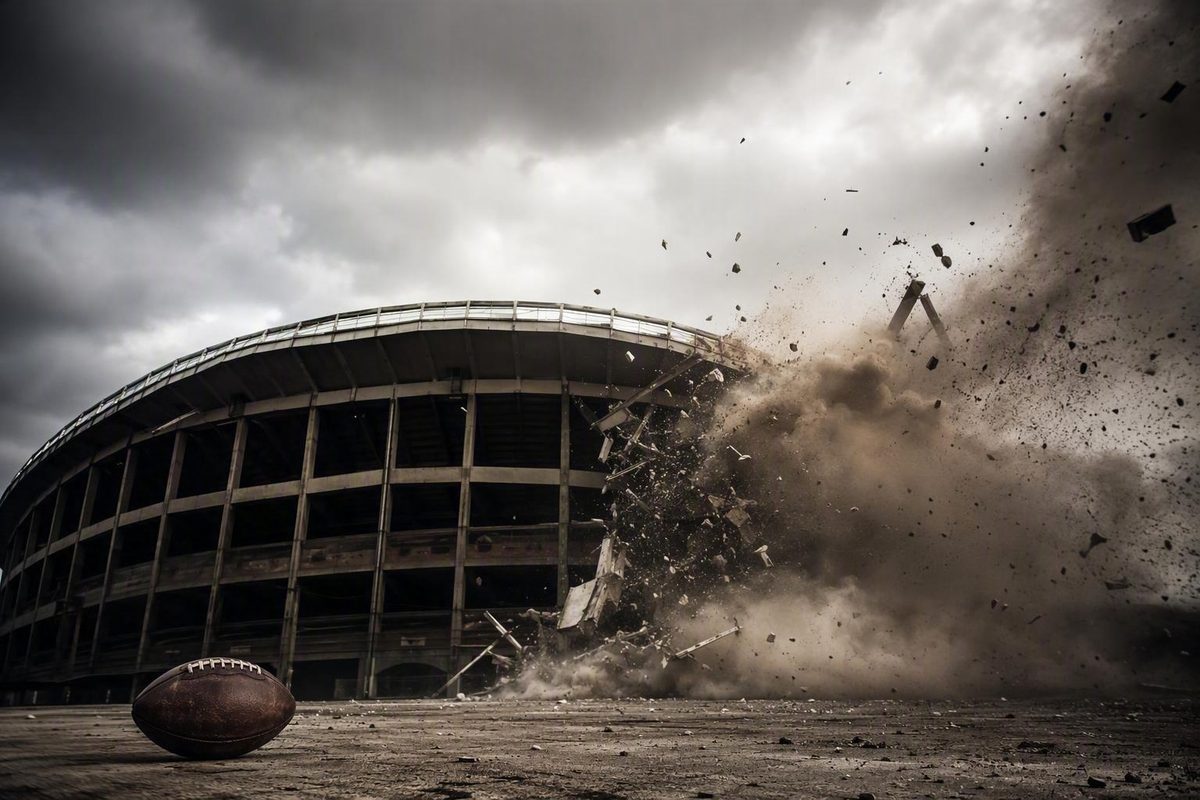
The football history of Atlanta–Fulton County Stadium, from the Falcons’ 1966 debut and first playoff win to the Georgia Dome move and 1997 implosion.
Atlanta–Fulton County Stadium is remembered most readily as the place where Hank Aaron hit home run No. 715. In American-football history, however, its defining achievement came before the Falcons had played a down: Atlanta built a stadium first, then secured an NFL team.
The circular, open-air venue gave the expansion Falcons a home from 1966 through 1991. It also showed the compromises of an era when cities routinely built one concrete stadium for baseball and football—and expected both sports to fit.
The stadium came before the Falcons
Mayor Ivan Allen Jr. had campaigned in 1961 on building a modern stadium to attract major-league baseball. Atlanta selected a 47-acre urban-renewal site near downtown and the interstate highways, broke ground on April 15, 1964, and completed the $18 million stadium on April 9, 1965. After the building was finished, the NFL awarded Atlanta an expansion franchise in June 1965; the club became the Atlanta Falcons. The sequence matters: the stadium was not constructed for an existing football team. It was part of Atlanta’s attempt to prove that the city was ready for major-league sports. The New Georgia Encyclopedia traces that stadium-to-franchise chronology.
That civic story had a substantial neighborhood cost. The Atlanta History Center places the project amid interstate construction and urban-renewal programs that displaced thousands of residents and closed businesses in and around Summerhill, Peoplestown and Mechanicsville. Its account says the stadium and surrounding parking lots added to the difficulties faced by residents who remained. That context complicates the familiar “major-league city” success story.
A multipurpose stadium that favored neither intimacy nor football sightlines
Originally called Atlanta Stadium, the building was renamed Atlanta–Fulton County Stadium during the Falcons’ tenure. It was a circular concrete-and-steel facility with three seating levels, holding about 52,000 for baseball and 62,000 for football. Its architects had to accommodate two fields with fundamentally different shapes inside one fixed seating bowl. The New Georgia Encyclopedia describes it as a functional multipurpose design typical of the 1960s and 1970s.
The cost of that flexibility was distance. In the football setup, the orientation left spectators around the 50-yard line roughly 50 yards from the action. The grass surface and open sky made it a recognizably traditional football setting, but the baseball geometry prevented the best seats from wrapping closely around the football field. SABR’s stadium history records both the awkward sightline and the venue’s attempt to satisfy baseball and football in one space.
From a 1966 loss to Atlanta’s first playoff victory
The Falcons’ first regular-season game at the stadium came on September 11, 1966. Atlanta lost 19–14 to the Los Angeles Rams. Twenty-five seasons later, the final NFL game there ended differently: the Falcons beat the Seattle Seahawks 26–13 on December 15, 1991. Pro Football Reference counts 194 Falcons games at the stadium from 1966 through 1991, with an 85–105–2 regular-season home record and a 1–1 playoff record. Its stadium record also identifies the grass surface and both endpoint games.
The solitary home playoff win was one of the franchise’s foundational games. On Christmas Eve 1978, Philadelphia led Atlanta 13–0 after three quarters. Steve Bartkowski then threw fourth-quarter touchdown passes to Jim Mitchell and Wallace Francis, and the Falcons won 14–13 after Eagles kicker Mike Michel missed a late field-goal attempt. It was Atlanta’s first playoff game and first playoff victory. The Falcons’ own retrospective recounts the comeback and the fans tearing down the goalposts; the game record confirms that both Atlanta touchdowns came in the fourth quarter.
That afternoon supplied a rare peak in a difficult stadium era. Across their 26 seasons there, the Falcons produced only six winning seasons. The building nevertheless became the physical setting for the franchise’s first generation: Tommy Nobis, Claude Humphrey, Steve Bartkowski, Alfred Jenkins, Gerald Riggs and Deion Sanders all played home games on its grass.
It was also a college-football venue
Atlanta–Fulton County Stadium’s football history extends beyond the Falcons. The Peach Bowl moved from Georgia Tech’s Grant Field to the stadium in 1971. The bowl’s official history says those outdoor homes gave the game exposure but could not protect spectators from the cold and precipitation that troubled early crowds. The game moved to the Georgia Dome in 1992. The Peach Bowl’s own timeline documents both moves.
The parallel is revealing. Both the Falcons and the Peach Bowl left the old stadium for the same new indoor venue in 1992. Atlanta–Fulton County Stadium had helped establish the city as a professional- and college-football market, but by then an open multipurpose bowl with distant football sightlines no longer represented what its major tenants wanted.
The football era ended before the stadium did
The Falcons moved into the Georgia Dome for the 1992 season, ending their 26-year run at Atlanta–Fulton County Stadium. The old building remained in use for baseball: the Braves stayed through 1996, and Olympic baseball was played there that summer. The stadium was imploded on August 2, 1997. The New Georgia Encyclopedia records the Falcons’ departure, the final baseball years and the demolition.
The structure is gone, but its location can still be read. The Atlanta History Center’s guide says the former outer wall’s circular outline and the baseball diamond’s footprint are marked in the parking area, with a surviving wall section commemorating Aaron’s 715th home run. Those traces identify the site of Atlanta’s first major-league sports venue.
For football, the stadium’s legacy is less a record of sustained success than one of entry and transition. It made Atlanta’s NFL bid credible, housed the Falcons’ first game and first playoff win, and then yielded to a purpose-built football dome. Its history captures the full life cycle of the multipurpose-stadium idea: civic ambition, imperfect shared geometry and eventual replacement.